Think, Collaborate & Do
Interdisciplinary Research Funding
CMI Ideation Event
Each year, the CMI holds the “Think, Collaborate & Do” Ideation event. This event invites faculty, graduate students and postdocs from all departments and colleges who have an interest in human and animal health to display a research summary poster that will allow them to make connections with potential collaborators they wouldn’t otherwise have met. They then form groups to come up with big, bold, new ideas in areas of focus to the CMI that become research proposals for the Ideation Awards.
These awards are our biggest funding opportunity of the year, with up to $250K available, with joint funding opportunities from Global One Health Academy (GOHA), Genetics & Genomics Academy, ICONS/ASSIST, and CMI’s Catalyze Entrepreneurship initiative. Read on below to find out more.

“Think, Collaborate & Do” Ideation Seed Funding Proposals
The 2026-2027 call for project proposals is now open! Proposals are due Friday, September 11th. Faculty & Associate Member RFPs are below. Joint funding opportunities from Global One Health Academy (GOHA), ICONS/ASSIST, and CMI’s CATALYZE Entrepreneurship initiative are available.
- Faculty Format Think, Collaborate & Do Proposal Format
- Associate Member Think, Collaborate & Do Proposal Format
“Think, Collaborate & Do” 2026
Thursday, August 13th, 2026
8:00 a.m.-12:50 p.m.
McKimmon Conference & Training Center
This year’s event will again be a combined event with the Research & Education Summit, with “Think, Collaborate & Do” in the morning and the Summit in the afternoon.
To participate in the morning event you must register and have a research summary poster to attend. Please look carefully at the sample posters. These are not traditional posters but specifically designed for this event. Examples are provided below for single-PI labs, graduate students and postdocs (Associate Members), as well as a group of faculty. Registration and digital poster uploads are due by Thursday, August 6th. Please bring your hard-copy posters with you to the event.
We are also seeking Associate Member volunteers to help run the event. To find out more or to sign up, use the “Volunteer” button below, or contact Valerie Baker Vella at [email protected].
Please Note: The McKimmon Center has ample free, dedicated parking.
Keynote Speaker

Dr. James “Jimi” Cook
After receiving his bachelor’s degree from Florida State University and competing for 5 years as a professional waterskier, Dr. James (Jimi) Cook completed his DVM in 1994 and PhD in 1998. In 1999, he founded the Comparative Orthopaedic Laboratory at the University of Missouri, a multi-disciplinary team of physicians, veterinarians, engineers, and basic scientists dedicated to translational orthopaedic research, which has now been endowed and moved into its own 12,000 sq ft facility as the Thompson Laboratory for Regenerative Orthopaedics. He has over 450 peer-reviewed publications, over $50 million in research funding, OTC and OTSC certifications to provide care for human patients, received numerous awards including America’s Best Veterinarian, The Marshall Urist Award from the Orthopaedic Research Society, and was a member of the inaugural CoMO 100 class recognizing those who shaped the city of Columbia, Missouri. He holds 42 patents including the MOPS® technology. He is currently Professor and the William and Kathryn Allen Distinguished Chair in Orthopaedic Surgery, Vice Chair of Orthopaedic Research, and Director of the Mizzou Joint & Limb Preservation Center at the University Hospital’s Missouri Orthopaedic Institute. He is also co-founder of Be The Change Volunteers a NGO dedicated to building schools in remote villages in the developing world whose teams have built 90 educational facilities in 17 countries, providing educational opportunities to more than 10,000 students.
“Think, Collaborate & Do” Agenda
- 8:00-8:30 Coffee, Sign-in & poster setup
- 8:30-9:00 Welcome & Intro
- 9:00-10:50 Learn & Mingle
- 10:50-11:20 Ideate, Consolidate & Finalize
- 11:20-11:30 Q&A, Closing Comments
- 11:30-12:50 Lunch, Guest Speaker Keynote Address

Ideation Posters
A research summary poster is required to effectively participate in this event. Posters should be 24×36″ with a portrait orientation. Please also include a photo of yourself (if a group, the photo of the person to talk to during the event) so that others can recognize you at the event. Templates available at the links below. Please note that these templates are only examples. Use whichever template fits your research best, and feel free to modify as appropriate as long as the meet the overall content format (simple and general).
Poster Printing Instructions
Free poster printing offered to the first 15-20 graduate students and postdocs who sign up and upload their posters via the above registration form by Monday, August 3rd, if they do not have access to poster printing by any other means. If you would like CMI to print your poster, please indicate that in the event registration form above.
Faculty, and graduate student and postdocs who have access to a departmental poster printer must print their posters on their own and bring the posters with them to the event.
Not sure what an Ideation event is? Here’s how it works:
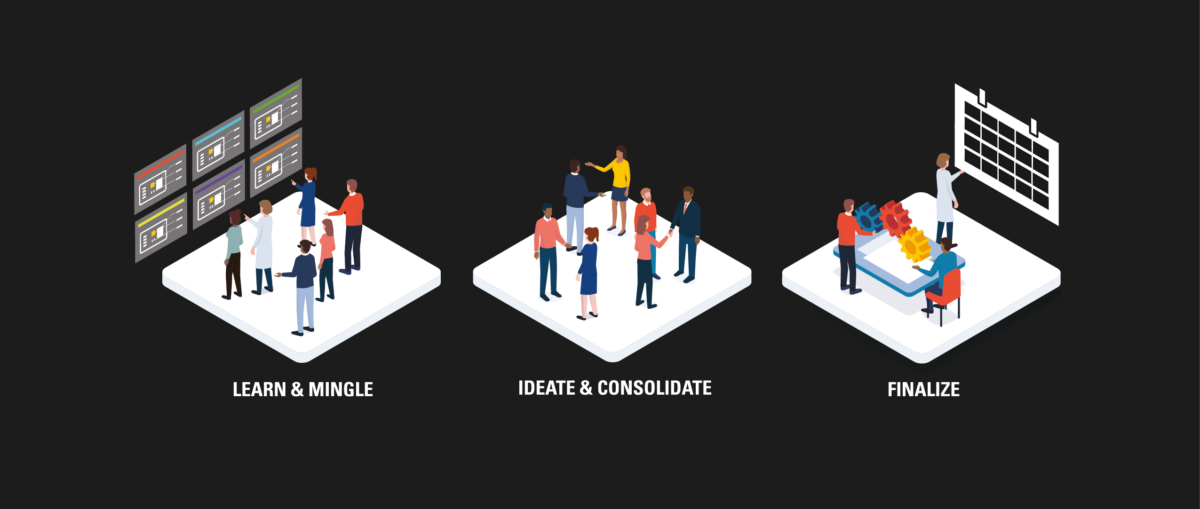
| Register to attend: | Submit your research summary poster Preview others’ posters electronically. |
| Learn & Mingle: | Posters will be displayed unattended to allow browsing Leave your contact info for those you’d like to meet. |
| Ideate & Consolidate: | Join groups and exchange ideas. |
| Finalize your ideas: | Plan follow-up meetings & write your proposal |
Have questions? Attend one of our virtual Q&A info sessions!
Choose from one of two upcoming dates:
- Monday, July 20th, 3:00-4:00 p.m. *please note the updated time for this session*
- Monday July 27th, 11:00-12:00 p.m.
Can’t attend in real time? View a recorded info session below (ncsu.edu email required).
2025-2026 Faculty Awards:
- Developing an agentic AI framework for single-molecule super-resolution imaging analytics
- PIs: Yang Zhang (WCOT), Caroline Laplante (CVM), and Dongkuan Xu (COE)
- Construction of Probiotic Lactobacillus-based vaccines for poultry using a stable recombinant-gene expression system via chromosomal integration
- PIs: Ravi Kulkarni (CVM), Rodolphe Barrangou (CALS), Sarah O’Flaherty (CVM)
- Hijacking the Round Window Membrane to Get Large Therapeutics into the Inner Ear
- PIs: Alon Greenbaum (COE), Amit Sharma (CVM)
- Visible Light Photon Upconversion-based Initiators Toward Deep Vat 3D Printing of Support-Free Soft Materials
- PIs: Yang Zhang (WCOT), Henry Ware (COS)
- Mechanics-informed machine learning to elucidate the interaction of mechanical loading parameters and cartilage tissue properties during repetitive cyclic loading
- PIs: Brian Diekman (COS), Mansoor Haider (COS)
- Non-Invasive, Real-Time Metabolic Profiling of Cancer Cells with Hyperpolarized NMR
- PIs: Thomas Theis (COS), Melanie Simpson (CALS)
- Quantitative Pull-Force Assessment as a Functional Comparative Measure of Strength and Health in Aging Companion Dogs
- PIs: Alper Bozkurt (COE), Margaret Gruen (CVM), Natasha Olby (CVM), David Roberts (COE)
- Development of computational models for the analysis of shunt repair in dogs with portal vein shunts
- PIs: Mette Olufsen (COS), Nathan Nelson (CVM)
- Identifying epigenomic mechanisms underlying persistent mast cell hyperactivity following developmental flame retardant exposure
- PIs: David Aylor (COS), Michele Battle (CVM)
- Engineering a Novel, Real-time Optical Assay to Evaluate Equine Intestinal Ischemia
- PIs: Caroline McKinney-Aguirre (CVM), Abraham Vazquez-Guardado (COE), Liara Gonzalez (CVM), Carla Lopez Cruz, Afra Anzumli
- Elucidating the role of peribronchial LGR5+ fibroblasts in orchestrating prostaglandin–neutrophil crosstalk in airway fibrosis
- PIs: Jorge Piedrahita (CVM), Rosemary Bayless (CVM)
2025-2026 Student Awards:
- Genomics Guided Pipeline for the Invention of Antimicrobial Biomaterials
- PIs: Luke Tucker (COE), Daniel Merselis (COS)
- Neutrophil-Targeted Microgel Immunotherapy Platform for Ex Vivo Equine Sepsis
- PIs: Ethan Pozy (COE), Megan Palmisano (CVM)
- From Molecular Affinity to Cancer Signaling: Decoding How Mutations Affects Cell–Cell Communication
- PIs: Yafan Zhang (COS), Zhuyang Lin (COS)
Questions?
Contact Valerie Vella ([email protected]) with event questions.
Contact Dr. Ashley Brown ([email protected]) with proposal or award questions.
Other Funding Opportunities Outside of this Event:
- Research Focus Area-specific opportunities: These seed grants vary year-to-year and are at the discretion of each area’s Associate Directors. Join the CMI & your preferred focus area to be notified when these awards are announced.
- Young Scholar Program (YSP) / Summer Interdisciplinary Research Initiative (SIRI) awards: Annually each fall semester. Graduate students & postdocs create interdisciplinary projects and select undergraduate students as lab assistants mentees. Details here & here.
- CATALYZE Entrepreneurship & Commercialization opportunities: Visit the Entrepreneurship page to learn more about the CATALYZE startup pitch contest, the Business and Medicine (BaM) program, and more.